
Last week, someone said something in a meeting that snapped me right out of my AI bubble: “People still use Google.”
I burst out laughing. Not because it was funny, but because it’s absurd that we needed this reminder.
I spend every day inside a company that wouldn’t exist without AI. It is the product we sell, the thing we use to make that product, and the colleague I annoy on Slack the most. Our conversations bounce between AGI, MCPs, reasoning models, and autonomous workflows.
I actively dread to think about how many times the word agent passes through my brain every day (at least AI can’t read my thoughts and tell me...yet.)
After a while, you stop noticing how unusual these conversations actually are, and start subconsciously assuming everyone else is having them too.
They’re not. Most people aren’t building AI agents. Most people aren’t even using AI at all. And if they are, they’re probably asking it to help write an email, summarise a PDF, or plan their holiday. And yes, people definitely still google things.
So when did we decide everyone speaks fluent AI? If you spend long enough in the bubble, it’s dangerously easy to mistake your own behaviour for everyone else’s. That has some pretty significant consequences:
We build products for ourselves instead of the people we’re trying to serve. If everyone in the room assumes the user already understands agents, MCPs and prompting, you stop explaining the human benefits properly.
We start solving tomorrow’s problems before today’s problems are understood. The industry is debating autonomous agent swarms while most of our pals are still trying to work out if it’s okay to paste meeting notes into ChatGPT.
We mistake early adopters for the market. Yup that classic mistake. You end up optimising for the loudest 1% instead of the next 99%.
Silicon Valley isn’t helping
If there’s one place on Earth that should be able to nail how to talk about AI, it’s San Francisco.
But on my last visit, every other billboard seemed to say the same thing. AI-native. AI-powered. AI for your agents. Agents for your AI. AI was everywhere, but the reason I should care wasn’t.
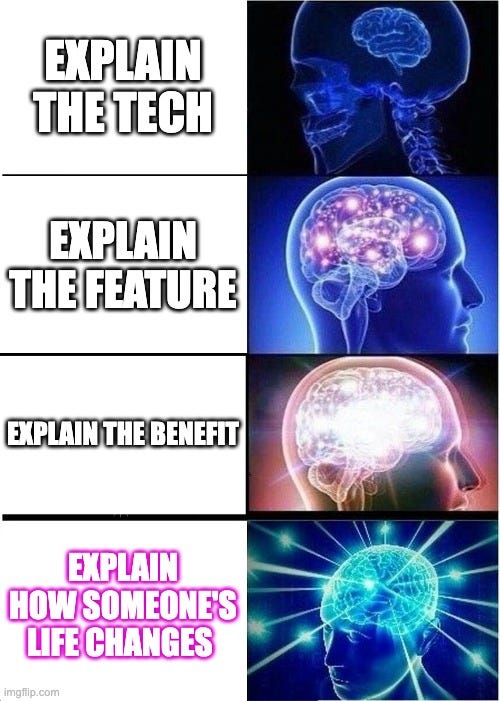
One night, I was nursing a watery cocktail at an AI conference after-party while Fergalicious blasted through the speakers, and an investor yelled into my ear: “We literally have driverless cars all around us and no one bats an eyelid. But if an AI agent manages to click through two browser tabs, everyone loses their shit.”
He’s right. We’ve become obsessed with demonstrations of capability while doing a remarkably poor job of explaining why any of it matters for society at large.
We’ve seen this all before
Every major technological shift invents its own language. The people at the frontier naturally become obsessed with the technology they’re building, how it works, and what it can do.
Before long, you have an entire industry talking about infrastructure, architectures, protocols and frameworks, while everyone else is still asking one simple question:
What’s in it for me?
Nobody wants cloud infrastructure. They want their photos, files and music to be there wherever they are.
Nobody wants a ride-sharing platform. They want to get home to their dog.
Nobody wants a music recommendation algorithm. They want to hear a song that lights up their soul.
I don’t think anybody really wakes up in the morning jazzed to use AI agents either. They want to spend less time doing mind-numbing admin. Start the company they’ve been talking about for years. Build an app to help their community with something. Leave work in time to have dinner with their kids.
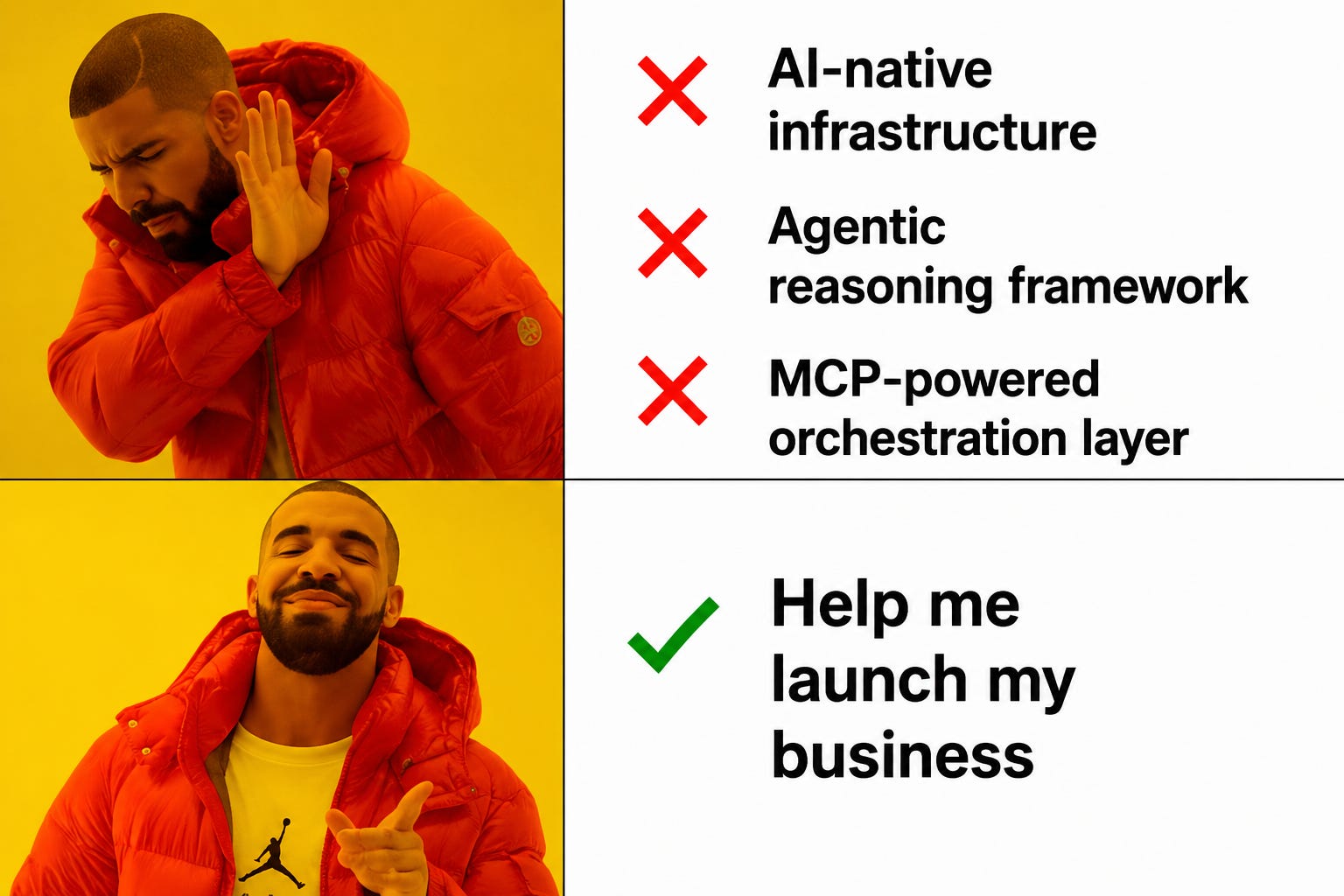
The technology has extraordinary potential, but it isn’t the story. The story is about what human beings can do because that technology exists. We’re spending so much time talking about AI that we’re forgetting to explain the real transformation.
This isn’t just a marketing problem.
Engineering moves technology forward. Communication brings people on the journey.
The danger is assuming everyone else has already caught up. They haven’t, and that’s okay.
We always seem to treat communication as something that happens after innovation. Build things and put them into the world first, explain why people (beyond immediate shareholders) should care later.
But I’m starting to think AI flips that. The technology is moving faster than society’s ability to understand it, which means the bottleneck isn’t always capability anymore, it’s comprehension.
Maybe I’m biased. I work in product marketing, so of course I’m going to say communication matters. But I don’t think this is just about marketing anymore, I think it’s about stewardship.
The stories we tell about AI will shape how people understand it, trust it, regulate it and ultimately decide whether it deserves a place in their lives.
If all we give people is “AI-native”,“agentic” and “accelerated transformation”, we’re stumbling at the first hurdle.
Our job isn’t to make AI sound more intelligent, it’s to make it understandable. To explain not what the technology is, but what a person can actually do with it, and how they can use it safely, responsibly and well.
If we want AI to change the world for the better, we can’t just build better AI. We have to tell better stories.
Gemma x
Ah so true! Thanks for sharing!
And let me add one more layer through my private school owner lenses: Half the world now wants all this AI craziness enter educational institutions with little to no evidence about what is at stake.
Thousands of startups working on all kinds of technology they think kids should need without ever spending a full academic year with the same group of kids and watching them grow.
I am all AI, one of the firsts trying out new stuff, the early adopter of the early adopters group BUT I believe we have to think well beyond investors profit in this case.
Thank you again for your toughs, and yes, let’s get out our our bubbles and circles to see the real world and the value we can create for it. 🙏❤️
Couldn’t agree more. As a PMM working on Brazil’s first ecommerce copilot, since the begining the journey has been about what problem are we actually solving and how to better resonate with the audience. After all, the user doesn’t care if It’s AI, workflow, or whatever lies behind the screen. As long as it can make their lives better, that’s what they will go after. April Dunford Said it well on an article she published recently: back to basics, we are still making products for people and the POV, the narrative, it is going to be one the most important assets when differentiating your product.